TL;DR: The AMD Ryzen 7 7800X3D has dropped to £336 on Amazon UK — roughly £70 cheaper than the Ryzen 9 9800X3D, which currently sits at around £400. The 7800X3D remains an elite gaming CPU in 2026 thanks to its single-chiplet design and 96MB of stacked L3 V-Cache, delivering performance that beats more expensive dual-chiplet CPUs in gaming workloads. Its only real weakness is content creation, where it falls behind even the base Ryzen 5 7600X. If gaming is your priority and you’re on AM5, this deal is difficult to argue against.
There’s a strong argument that the AMD Ryzen 7 7800X3D is the best value gaming CPU available in early 2026 — and right now, it’s even better value than usual. The chip has dipped to £336 on Amazon UK, bringing it approximately £70 below the price of its newer sibling, the Ryzen 9 9800X3D, which is currently hovering just above £400.
That price gap matters. The 9800X3D is the faster chip on paper, built on AMD’s newer Zen 5 architecture and with higher boost clocks. But the performance delta between the two in actual gaming workloads — which is what the V-Cache range is purpose-built for — is notably smaller than the price gap might suggest. Unless you’re specifically chasing the absolute top of the benchmark table, the 7800X3D at £336 is genuinely hard to argue against.
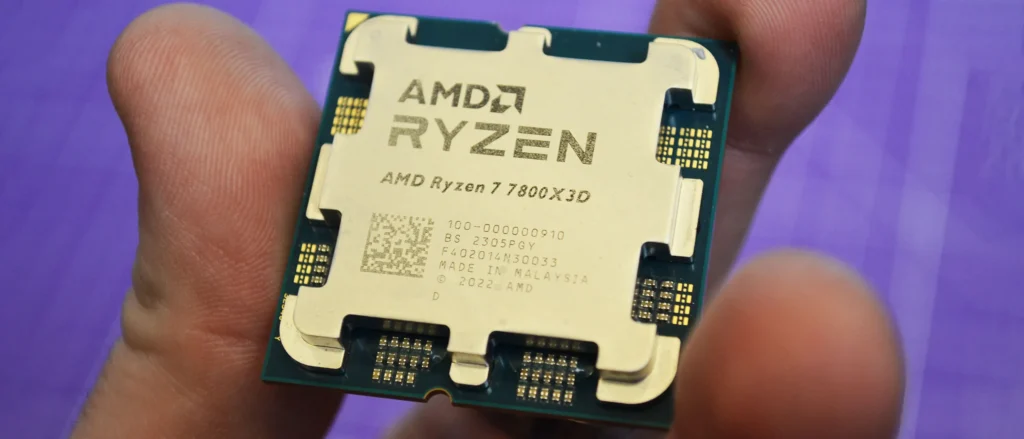
What Makes the 7800X3D So Good for Gaming
The 7800X3D’s party trick is its 3D V-Cache: a massive 96MB of L3 cache stacked vertically on top of the compute die, bringing the total cache to 104MB. In CPU-bound gaming scenarios, that cache allows the chip to serve more data to the processor cores without waiting on slower system memory — which is why it consistently punches above its weight against chips with more cores, higher frequencies, and higher price tags.
What’s particularly counterintuitive about the 7800X3D is that its single-chiplet design — which on paper sounds less impressive than the dual-chiplet 7900X3D and 7950X3D — actually works in its favour for gaming. Dual-chiplet designs split the cache across two dies, which introduces latency when threads need to access data on the other die. The 7800X3D concentrates all eight cores and all of that V-Cache on one chiplet, giving it lower latency and faster in-game performance than AMD’s own more expensive X3D options in many titles.
In benchmark testing at 1080p — where CPU performance is most exposed — the results speak for themselves. In Microsoft Flight Simulator 2020, the chip delivers around 96.7fps. In Metro Exodus Enhanced Edition, it pulls ahead of AMD’s own 7950X3D and Intel’s then-flagship Core i9-13900K with a result of 299.28fps. The pattern holds across most CPU-limited games: the 7800X3D trades blows with chips costing significantly more, and often wins.
Its 120W TDP is also notably modest for a top-tier gaming processor. It runs cool enough that a mid-range tower cooler is perfectly adequate — a large AIO or a high-end air cooler like the Noctua NH-D15 is comfortable overkill. That makes it a practical choice for compact builds as well as full towers.
One Real Weakness: Content Creation
The 7800X3D’s trade-off is well-established but worth flagging clearly. Its architecture is optimised for gaming at the expense of productivity workloads. In synthetic CPU benchmarks and real-world content creation tasks — video encoding, 3D rendering, multi-threaded compilation — the chip falls noticeably behind not just AMD’s non-X3D Ryzen 7000 chips, but even the base-tier Ryzen 5 7600X. Intel’s Core Ultra 7 265K also holds a clear advantage in professional workloads.
For most gamers, that trade-off is irrelevant. If you’re encoding video in Handbrake, exporting timelines in DaVinci Resolve, or running simulations in creative software as your primary workload, the 7800X3D is the wrong tool. But if gaming is your core use case and everything else is secondary, the compromise is a theoretical one.
Is It Worth Buying in 2026?
The 7800X3D is now a generation old, and AMD’s Zen 5-based 9800X3D does edge it out in most gaming benchmarks. The AM5 platform has also continued to evolve, with newer EXPO-ready DDR5 kits and B650/X670 boards now widely available at competitive prices.
The 7800X3D stands out for its excellent price-to-performance ratio in gaming applications, and in 2026, it remains one of the best gaming-focused CPUs ever made for gamers seeking smooth frame rates, excellent efficiency, and strong value at discounted prices.
At £336 on Amazon UK, the 7800X3D sits in a compelling sweet spot: meaningfully cheaper than the 9800X3D, only a modest step behind it in gaming performance, and still ahead of most of what Intel has to offer in the same price bracket. For builders on a budget who don’t want to compromise on gaming frame rates, this is one of the stronger deals currently available in the UK CPU market.
If you’re upgrading from an older AM5 chip or building a new system from scratch, the 7800X3D at this price point deserves serious consideration before you spend an extra £70 on the marginal gains the 9800X3D offers.
Planning a new build around your next CPU purchase? Check out the best gaming PC builds under £1,500 for 2026 — including recommendations for which GPU and memory pairings work best with AM5 chips like the 7800X3D. And if you’re weighing up whether to build a PC at all, our console vs. gaming PC value breakdown covers exactly what you get for your money in 2026