Globle continues to test players’ geographical knowledge with its daily challenge of identifying a mystery country using color-coded proximity clues. Today’s puzzle for February 16, 2026 features a fascinating North African nation with rich history, stunning Mediterranean coastline, and significant cultural importance. Whether you’re a geography enthusiast or need some guidance, this comprehensive guide will help you navigate to today’s answer.
Looking for more daily puzzle challenges? Check out our Bandle Hints and Answer for February 16, 2026 and Wordle Today 1703 Hints and Answer guides.
What is Globle?
Globle is a geography-based daily puzzle game where players attempt to identify a mystery country by making guesses on an interactive globe. After each guess, the country you selected is colored based on its proximity to the target country: the closer your guess is geographically, the warmer (redder) the color. Cold colors like white or light blue indicate you’re far away, while hot colors like red mean you’re very close. The goal is to identify the correct country in as few guesses as possible.
How to Play Globle Strategically
Before diving into today’s specific hints, here are proven strategies to improve your Globle performance:
Start with central reference points. Beginning with countries in different continents helps you quickly narrow down which region of the world contains the target.
Use the color gradients wisely. Pay attention to how the colors shift between your guesses to determine which direction to move.
Think about neighboring countries. Once you’re in the warm color range, systematically guess countries that border your previous attempts.
Consider physical geography. Mountain ranges, seas, and continental boundaries often define country locations.
Remember smaller nations. Globle includes every country, including island nations and smaller territories that might not immediately come to mind.
General Geographical Hints (No Spoilers)
Let’s start with broad clues that won’t immediately give away the answer:
Hint 1: Continental Location
Today’s mystery country is located in Africa, specifically in the northern region of the continent. It has coastline access to a major body of water that connects multiple continents.
Hint 2: Regional Classification
This country is part of both the African continent and the Arab world. It’s considered part of the Maghreb region, which comprises the western portion of North Africa.
Hint 3: Climate and Geography
The country features diverse geography including Mediterranean coastline in the north, fertile agricultural regions, and access to the Sahara Desert in the south. The climate varies from Mediterranean along the coast to arid in the southern regions.
Hint 4: Size and Population
This is a medium-sized country by African standards, neither among the continent’s largest nor smallest. Its population is moderate, placing it in the middle tier of African nations by demographic size.
Hint 5: Historical Significance
The country has an incredibly rich history dating back thousands of years, including ancient civilizations, Roman presence, and Islamic influence. It played important roles in various historical periods including ancient times and World War II.
Strategic Guessing Path
If you’re working through Globle systematically, here’s how your guesses might progress:
If you started with Egypt:
You’re in the right region! The color should be relatively warm, indicating you’re in North Africa. The target country is west of Egypt.
If you started with Morocco:
You’re also in the correct region and getting a warm color. The target country is east of Morocco along the Mediterranean coast.
If you started with Algeria:
Excellent guess! You’re very close now. Algeria shares a long border with the target country to the east.
If you started with Libya:
You’re in the right neighborhood. The target country is directly west of Libya, sharing a border.
Neighboring Countries Hint
Hint 6: Border Information
Today’s mystery country shares land borders with exactly two countries: Algeria to the west and Libya to the east. This should significantly narrow your options if you’ve identified the region.
Cultural and Economic Hints
Hint 7: Cultural Identity
The country has a predominantly Arab-Muslim population, though it also has significant Berber heritage. French is widely spoken due to colonial history, alongside Arabic as an official language.
Hint 8: Economic Profile
Tourism plays a significant role in the economy, with visitors attracted to Mediterranean beaches, ancient ruins, and desert landscapes. The country also has agricultural exports, particularly olive oil, and some petroleum resources.
Hint 9: International Relations
This country is a member of the African Union, the Arab League, and the United Nations. It has maintained relationships with both Western nations and Arab states throughout its modern history.
Historical Clues
Hint 10: Ancient History
The territory was home to the ancient city of Carthage, one of the most powerful civilizations in the ancient Mediterranean world. Carthage famously competed with Rome for dominance, leading to the Punic Wars.
Hint 11: Colonial Past
The country was a French protectorate for much of the 20th century before gaining independence in the 1950s. This French influence remains visible in language, architecture, and cultural practices.
Hint 12: Modern History
The country played a significant role in the Arab Spring movement that began in 2010-2011, where popular protests led to major political changes across the Arab world.
Capital City Hint
Hint 13: Capital Information
The capital city shares the same name as the country itself. It’s located on the Mediterranean coast and serves as the economic, political, and cultural center. The city has a historic medina (old town) and modern districts.
Geographical Details
Hint 14: Mediterranean Coastline
The country has approximately 1,300 kilometers of Mediterranean coastline, featuring beautiful beaches, coastal cities, and important ports. This coastline has been strategic throughout history for trade and military purposes.
Hint 15: Notable Geographical Features
The country contains portions of the Atlas Mountains in the north and extends into the Sahara Desert in the south. It includes salt lakes (chotts) and diverse ecosystems from coastal areas to arid desert regions.
Cultural Landmarks Hint
Hint 16: UNESCO World Heritage Sites
The country boasts multiple UNESCO World Heritage Sites, including the ancient ruins of Carthage, the medina of its capital city, and the well-preserved Roman amphitheater at El Djem, one of the largest in the world.
Final Hint Before the Answer
Hint 17: Name Origin
The country’s name comes from its capital city, which in turn derives from a Berber root. The name has been used since ancient times and is closely associated with both the modern nation and its historical territories.
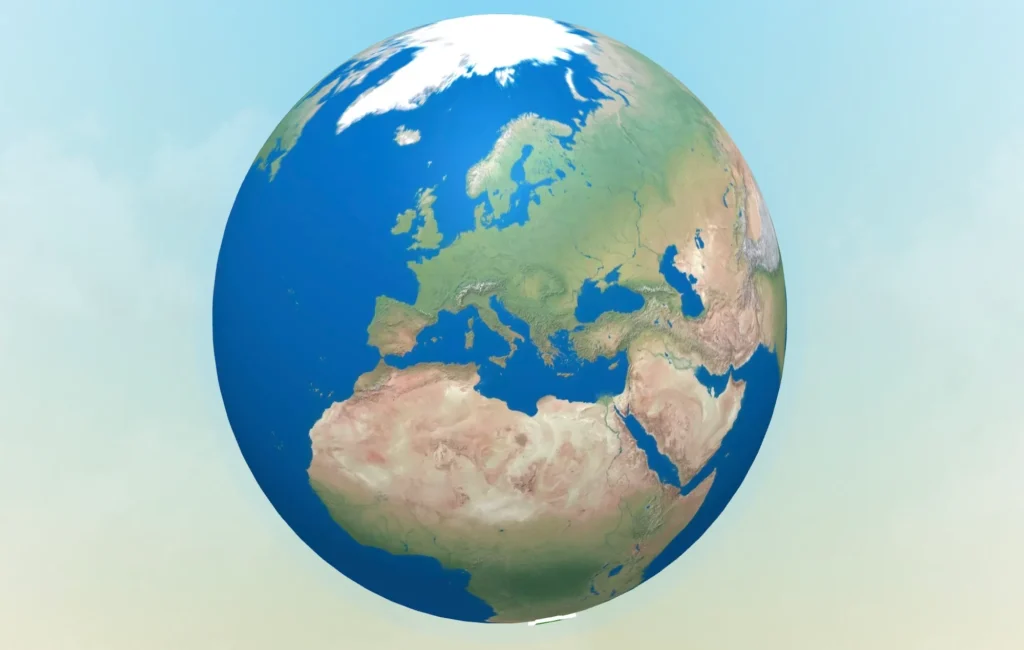
Globle Answer for February 16, 2026
The answer to today’s Globle is: TUNISIA
About Tunisia
Tunisia is a North African country strategically located on the Mediterranean Sea, bordered by Algeria to the west and Libya to the east. With an area of approximately 163,610 square kilometers (63,170 square miles), it’s the smallest country in the Maghreb region but boasts outsized historical and cultural significance.
Geographical Overview
Tunisia’s geography is remarkably diverse for its size. The northern region features fertile plains and the eastern extension of the Atlas Mountains, creating a Mediterranean climate ideal for agriculture. The central region transitions to semi-arid steppes, while the south extends into the Sahara Desert, home to stunning sand dunes and occasional oases.
The country’s 1,300-kilometer Mediterranean coastline has been crucial throughout history, facilitating trade, cultural exchange, and maritime activities. Major coastal cities include Tunis (the capital), Sfax, Sousse, and Bizerte.
Historical Significance
Ancient Carthage:
Tunisia’s territory was home to ancient Carthage, founded by Phoenician colonists in the 9th century BCE. Carthage became one of the ancient world’s most powerful civilizations, controlling trade routes across the Mediterranean and establishing colonies throughout North Africa, Spain, and the islands.
The Punic Wars (264-146 BCE) between Carthage and Rome were among history’s most consequential conflicts. Carthaginian general Hannibal’s crossing of the Alps with war elephants remains legendary. Ultimately, Rome destroyed Carthage in 146 BCE, later rebuilding it as a Roman city.
Roman and Byzantine Periods:
Under Roman rule, Tunisia prospered as a major agricultural province supplying grain to Rome. Magnificent structures like the El Djem amphitheater (built around 238 CE) showcase the wealth and architectural sophistication of Roman Africa. The region later became part of the Byzantine Empire before Arab conquest.
Islamic Era:
Arab armies brought Islam to Tunisia in the 7th century CE, establishing Kairouan as one of Islam’s holiest cities. The subsequent Islamic dynasties, including the Aghlabids and Fatimids, made Tunisia a center of learning and culture.
Ottoman and French Periods:
Tunisia became an Ottoman province in the 16th century, enjoying considerable autonomy. In 1881, France established a protectorate, which lasted until Tunisia gained independence in 1956 under the leadership of Habib Bourguiba.
Modern History:
Tunisia garnered international attention in December 2010 when protests sparked by street vendor Mohamed Bouazizi’s self-immolation triggered the Jasmine Revolution. This movement spread across the Arab world as the Arab Spring, fundamentally changing the region’s political landscape.
Culture and Society
Tunisian culture blends Arab, Berber, Mediterranean, and French influences. Arabic is the official language, but French remains widely spoken in business, education, and media. The country has a relatively high literacy rate and has historically emphasized education.
Tunisian cuisine is renowned throughout North Africa, featuring dishes like couscous, brik (a fried pastry), harissa (spicy chili paste), and various Mediterranean-influenced seafood preparations. Olive oil production is significant both culturally and economically.
Economic Profile
Tunisia’s economy is diverse, including agriculture (particularly olives, dates, and citrus), phosphate mining, petroleum production, manufacturing, and tourism. The country has positioned itself as a manufacturing hub, particularly for automotive parts and textiles.
Tourism is crucial, attracting visitors to its Mediterranean beaches, Sahara Desert experiences, and numerous archaeological sites. The well-preserved Roman ruins, Islamic architecture, and traditional medinas provide rich cultural experiences.
Why Tunisia is Perfect for Globle
Tunisia presents an interesting challenge for Globle players:
Regional positioning between the larger countries of Algeria and Libya means players might overlook it initially when focusing on bigger North African nations.
Size considerations make it easy to guess neighboring countries and miss the actual target, especially when colors indicate you’re very close.
North African geography can be tricky for players less familiar with the region, as the Maghreb countries share similar geographic positions.
Coastal location along the Mediterranean provides good reference points once players narrow down to North Africa.
Strategy for Finding Tunisia
If you were working systematically toward today’s answer, the logical progression might have been:
- Continental identification: Guessing countries on different continents to get warm colors for Africa
- Regional narrowing: Trying Egypt or Morocco to identify North Africa specifically
- Neighbor testing: Guessing Algeria or Libya would put you immediately adjacent
- Final identification: Recognizing Tunisia as the country between these two larger neighbors
Did You Guess Correctly?
How many attempts did today’s Globle take you? Tunisia can be challenging if you’re not immediately familiar with North African geography, but once you narrow down to the region, the process of elimination makes it solvable.
If you found Tunisia quickly, congratulations! You have solid geographical knowledge of North Africa. If it took several guesses, you’ve now learned more about this fascinating country’s location and significance.
Tips for Tomorrow’s Globle
Each Globle puzzle enhances your world geography knowledge. Today’s focus on Tunisia teaches important lessons about:
- North African geography and the Maghreb region
- Countries bordered by both Algeria and Libya
- Mediterranean coastal nations in Africa
- Medium-sized countries that might be overlooked between larger neighbors
For tomorrow’s puzzle, remember to:
- Use systematic continental elimination when starting
- Pay close attention to color gradients between guesses
- Consider smaller countries when you’re getting very warm colors
- Think about regional groupings and which countries border each other
More Daily Puzzle Games
Enjoying your daily puzzle routine? Expand your challenge with these other games:
- Wordle – Test your vocabulary with today’s word puzzle. Check our Wordle Today 1703 Hints and Answer guide.
- Bandle – Identify songs from limited instruments. Try our Bandle Hints and Answer for February 16, 2026.
- NYT Strands – NYT Strands Hints and Answers with Spangram Solved
Conclusion
Tunisia, with its strategic Mediterranean location, rich historical legacy, and diverse geography, makes an excellent Globle challenge. From ancient Carthage to modern times, this North African nation has played significant roles in Mediterranean and world history.
Whether you identified Tunisia immediately or needed some hints to narrow down the region, you’ve now expanded your geographical knowledge. Come back tomorrow for another Globle adventure, and keep exploring the world one country at a time!