Welcome to another day of NYT Strands! Today’s puzzle features a theme that’s all about personal viewpoints and perspectives. If you’re struggling to find the words hidden in the letter grid or can’t quite decipher the theme, we’ve got you covered with strategic hints and the complete solution.
What is NYT Strands?
NYT Strands is The New York Times’ captivating daily word puzzle that puts a fresh spin on traditional word searches. Instead of being given a list of words to find, you must discover theme-related words hidden within a letter grid based solely on a cryptic clue.
The challenge includes finding a special “spangram”—a word or phrase that spans from one side of the board to the other while perfectly encapsulating the puzzle’s theme. The ultimate goal is to use every single letter in the grid exactly once, creating a satisfying and complete solution.
How to Play NYT Strands
Master the game with these essential rules:
- You’re given a 6×8 grid filled with letters
- A cryptic theme clue guides your word search
- Connect adjacent letters (horizontally, vertically, or diagonally) to form words
- Each letter can only be used once per word
- Find all theme-related words
- Locate the “spangram” that touches two opposite sides of the board
- Use every letter in the grid exactly once
- Struggling? Find three non-theme words to unlock a hint
Today’s Theme: “If you ask me…”
The theme for December 27, 2025, is: “If you ask me…”
This phrase is commonly used when someone is about to share their personal thoughts or beliefs about something. Think about what follows when someone says “If you ask me…” or “In my opinion…” The theme revolves around words and phrases that describe personal viewpoints, judgments, and ways of looking at things.
Theme Interpretation
Today’s puzzle focuses on words related to opinions and viewpoints. You’re looking for terms that describe how people see things, their personal takes on matters, and different ways of expressing one’s perspective on a topic.
Strategic Hints for Finding Words
Before diving into specific answers, here are some approaches to help you solve the puzzle:
General Word Categories
- Think about synonyms for “opinion”
- Consider words related to “viewpoint”
- Look for terms describing personal beliefs
- Remember words about how someone sees something
- Think about expressions related to personal judgment
Word Length Clues
- You’re looking for words ranging from 4 to 11 letters
- One word is particularly long (11 letters)
- Several words are compound or two-part words
- The spangram is a common idiomatic expression
Letter Pattern Tips
- Look for common prefixes like “OUT-” or “PER-“
- Some words might be single words, others compound
- Watch for words that share similar meanings
- The spangram is a three-word phrase
Specific Word Hints
Let’s break down clues for each word without fully spoiling them:
Word 1: A Long, Formal Term
- 11 letters
- A formal way of describing someone’s viewpoint
- Often used in academic or professional contexts
- Starts with P and ends with E
- Contains the word “spec” within it
Word 2: Informal Opinion
- 4 letters
- Very casual way to say “opinion”
- “What’s your ___ on this?”
- Also means to grab or grasp something
Word 3: Most Common Term
- 7 letters
- The most straightforward word for personal belief
- “In my ___…”
- Ends with the suffix “-ion”
Word 4: Future-Oriented View
- 7 letters
- How you see the future or situation ahead
- “The ___ is positive”
- Starts with OUT-
Word 5: What You See
- 4 letters
- A simple word for what you can see or perceive
- “From my point of ___”
- Often paired with “point”
Word 6: Vantage Position
- 5 letters
- Often combined with “view”
- “From this ___…”
- A location or position from which you observe
The Spangram Hint
The spangram perfectly captures the theme of sharing opinions:
- It’s a common idiomatic expression about offering your opinion
- Three words totaling 10 letters (with spaces)
- Involves money and numbering
- Means “here’s my opinion” in casual language
- Touches opposite sides of the board
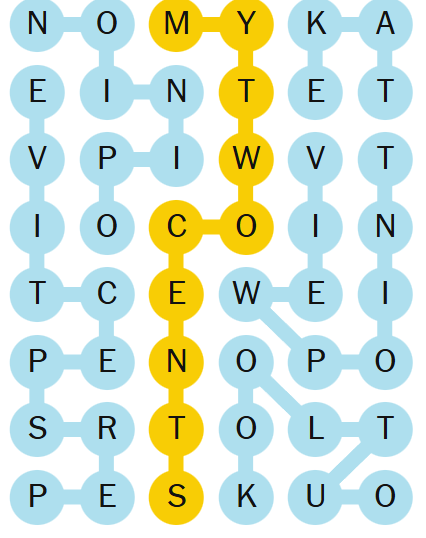
Complete Answers for December 27, 2025
Ready for the full solution? Here are all the theme words and the spangram:
Theme Words:
- PERSPECTIVE – A comprehensive way of viewing or understanding something
- TAKE – An informal opinion or interpretation (“What’s your take?”)
- OPINION – A personal view, belief, or judgment
- OUTLOOK – One’s general view of life or a situation, especially regarding the future
- VIEW – A way of seeing or considering something
- POINT – As in “point of view” – a particular attitude or perspective
Spangram:
MY TWO CENTS – A common idiom meaning “my opinion” or “what I think,” often used when offering unsolicited advice or personal perspective
Understanding Today’s Theme
The brilliance of today’s puzzle lies in how it explores the many ways we express personal viewpoints in English. “If you ask me…” is a conversational opener that signals someone is about to share their perspective, and the theme words represent various ways we describe opinions and viewpoints:
- Perspective – The most comprehensive and formal term
- Take – The most casual and modern
- Opinion – The standard, straightforward term
- Outlook – Emphasizes future-oriented perspectives
- View – Simple and versatile
- Point – Short for “point of view”
The spangram “MY TWO CENTS” perfectly encapsulates the theme with an idiom that literally means “here’s my opinion.” The phrase originated from the idea that one’s opinion is worth “two cents”—a small contribution to a conversation.
The Etymology of “My Two Cents”
The phrase “my two cents” (or “two cents’ worth”) is an American idiom dating back to the early 20th century. It derives from the older British expression “my two pennies’ worth.” The phrase suggests that one’s opinion, while perhaps not extremely valuable (just two cents), is still worth contributing to the discussion. Interestingly, there’s also the phrase “put in your two cents,” which means to offer your opinion, especially when it wasn’t requested!
Strategies for Solving NYT Strands
Improve your Strands game with these proven techniques:
Starting Strong
- Analyze the theme clue carefully – Look for puns, idioms, or figurative meanings
- Brainstorm theme-related words – List synonyms before looking at the grid
- Scan for familiar patterns – Your brain recognizes words faster than individual letters
- Search for the longest words first – They’re often easier to spot and eliminate many letters
Mid-Game Tactics
- Use hints strategically – Three non-theme words unlock a theme word hint
- Track which letters you’ve used – Helps prevent confusion
- Look for word fragments – “TION,” “NESS,” “ING” can reveal word locations
- Consider compound words – Theme words might be two words combined
Advanced Approaches
- Think about word relationships – Theme words often form semantic families
- Visualize the spangram’s path – It must span the board edge-to-edge
- Use elimination – Remaining letters must form remaining words
- Watch for overlapping letters – Words might share boundaries
Common Strands Pitfalls
Be aware of these frequent challenges:
- Overthinking the theme – Sometimes the simplest interpretation is correct
- Missing obvious words – Familiarity can make words invisible
- Ignoring the spangram – Finding it early can unlock the entire theme
- Forgetting compound words – “Viewpoint” is one word, not two separate finds
- Letter tracking errors – Easy to accidentally reuse letters
Why We Express Opinions Differently
Today’s puzzle highlights the rich vocabulary English offers for expressing viewpoints. Different contexts call for different terms:
- Formal settings: Perspective, viewpoint, position
- Casual conversation: Take, my two cents, opinion
- Future-focused: Outlook, forecast, projection
- Neutral descriptions: View, standpoint, angle
This linguistic variety allows us to convey subtle differences in how strongly we hold beliefs, how formal the setting is, and whether we’re discussing present realities or future possibilities.
More Daily Puzzle Games
Conquered today’s Strands? Try these other daily challenges:
- Wordle 1652 – Today’s five-letter word puzzle
- Quordle – Solve four words simultaneously
- Bandle – Identify songs from isolated instruments
- Globle – Geography challenge with heat maps
- Worldle – Guess countries from their silhouettes
Tips for Future Strands Puzzles
Prepare yourself for upcoming challenges:
- Build your vocabulary – The broader your word knowledge, the better
- Study idioms and expressions – Strands loves wordplay
- Practice pattern recognition – Train your eye for letter combinations
- Think laterally – Theme clues often require creative interpretation
- Stay current – Themes sometimes relate to dates or current events
- Review previous puzzles – Patterns emerge in how themes are constructed
The Psychology of Opinions
Today’s theme touches on something fundamental to human communication: how we express our thoughts and beliefs. The variety of words we use reflects different levels of:
- Certainty: “Opinion” vs. “perspective” vs. “take”
- Formality: “Perspective” vs. “my two cents”
- Scope: “View” (narrow) vs. “outlook” (broad)
- Temporality: “Opinion” (present) vs. “outlook” (future)
This linguistic richness allows us to communicate not just what we think, but how confident we are, how seriously we want to be taken, and what timeframe we’re considering.
Final Thoughts
Whether you cracked today’s opinion-themed puzzle immediately or needed some hints to unlock the viewpoint vocabulary, the important thing is engaging your brain and appreciating the clever wordplay. The “If you ask me…” theme elegantly explores how we share our thoughts and perspectives in everyday language.
Did you spot “MY TWO CENTS” right away, or did the various opinion words keep you searching? Tomorrow brings a fresh grid, a new theme, and another opportunity to flex your word-finding muscles. Keep that lateral thinking sharp and remember: every puzzle is worth at least your two cents!