While Aerospace Materials won’t directly boost your Operators’ combat stats, ignoring them is a critical mistake. These specialized resources are the lifeblood of the OMV Dijiang—Endfield Industries’ orbital headquarters in geostationary orbit above Talos-II. By investing in these materials, you unlock the Control Nexus upgrades and Cabin constructions that power your entire passive resource generation loop.
Crucially, Aerospace Materials cannot be crafted, dropped from enemies, or obtained through any other method in the game. Recycling Stations are their only source—which makes consistent daily collection more important than most players realize early on.
Looking for more? For comprehensive coverage of all game systems, visit our [Arknights: Endfield guides hub], featuring deep dives into everything from tactical combat to advanced base management.
The Two Types of Aerospace Materials
There are two distinct variants of Aerospace Materials, and understanding the difference matters for planning your upgrades:
- Aerospace Material I — The basic construction material. Used to upgrade Basic Cabins on the OMV Dijiang and for early-level Control Nexus improvements. Available from base-level Recycling Stations.
- Aerospace Material II — The advanced industrial variant (purple rarity). Required to upgrade Cabins beyond level two and for higher-tier Control Nexus upgrades. Only becomes available once you upgrade a Recycling Station to at least Level 3.
Both types drop from the same Recycling Stations, and you’ll often receive a mix of both when visiting upgraded stations. The split between Aerospace Material I and II in each batch depends on the station’s current upgrade level.
Finding All Recycling Stations Across Talos-II
Aerospace Materials break the mold compared to other resources in Endfield — they can’t be looted, mined, or crafted. They’re exclusively obtained through Recycling Stations distributed across the game’s regions.
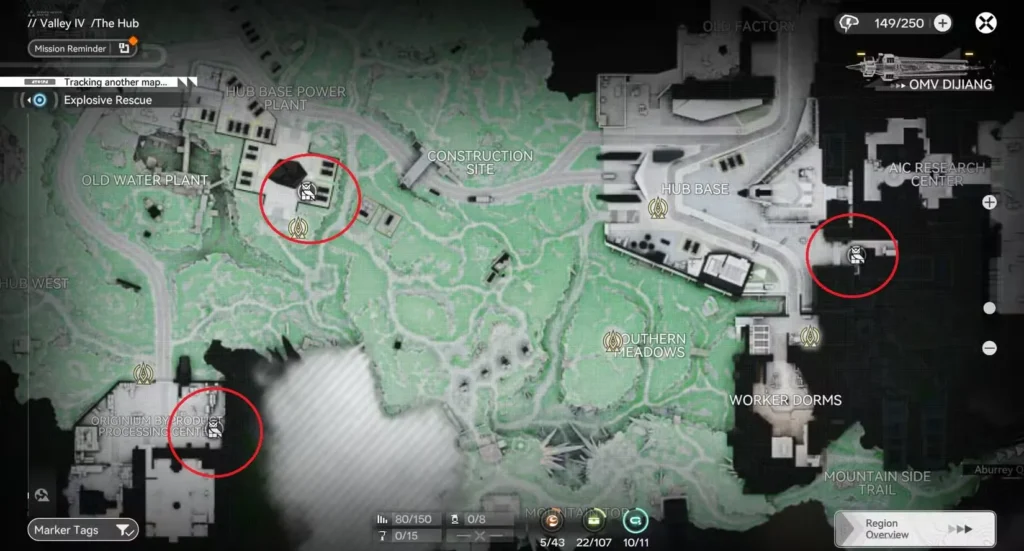
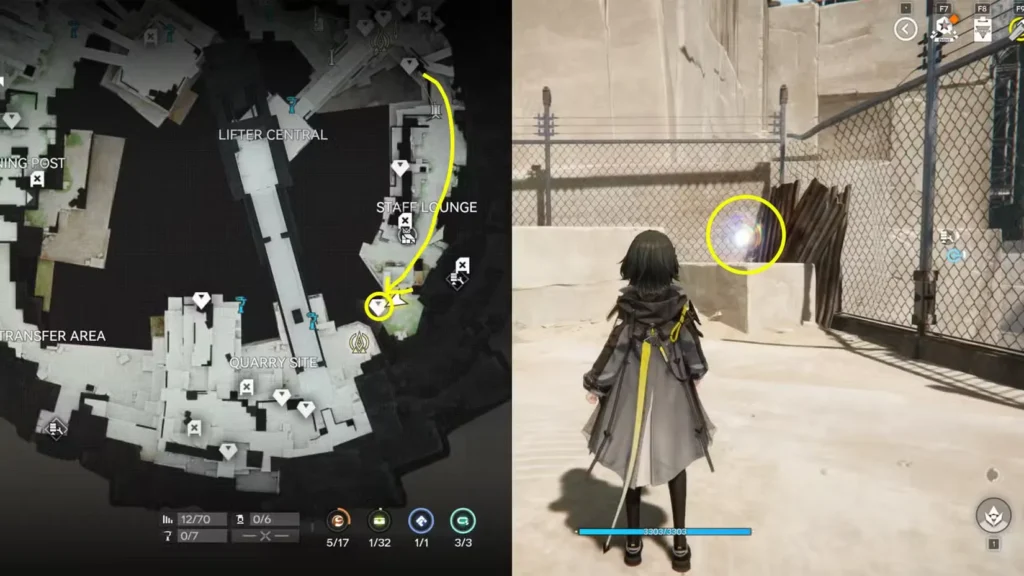
Locating these stations is straightforward — scan your map for owl-shaped icons marking their positions. In appearance, they look like a small owl-like creature wearing a yellow box, which rises from a resting position when you approach and the station is ready to collect.
There are 13+ Recycling Stations confirmed across the current game world, split across two main regions:
Valley IV Stations (9 total)
- The Hub — 3 stations (including one at the Processing Center and one at the Hub Base Power Plant, next to the Protocol Resonance Tower). These are the easiest to reach early in the game and should be your first upgrade targets.
- Valley Pass — 1 station (on the left side of the map — easily accessible and one of the first you’ll encounter)
- Aburrey Quarry — 1 station (in the Staff Lounge area)
- Originium Science Park — 2 stations
- Origin Lodespring — 2 stations (further north)
- Power Plateau — 2 stations (continue looking for owl icons as you move through this area)
Wuling Stations (4 total)
- Jingyu Valley — 3 stations
- Wuling City — 1 station
Activating a Recycling Station costs nothing. Walk up to one, interact with it, and immediately claim your first batch of Aerospace Materials. Some stations require story or Outpost progression to become accessible, so don’t worry if a few are locked early on.
Daily Reset and Collection Rules
All Recycling Stations reset once per day at 5:00 AM server time (approximately every 10 hours based on community data, though the daily server-time reset is the reliable window). A few important rules to know:
- Materials do not stack. If you skip collecting, the station holds one full batch — but it won’t accumulate additional batches for days you miss. There’s no overflow bonus for waiting.
- No central collection point. You must visit each station individually. However, most stations are placed near fast-travel Tele-Protocol Points, so full collection runs are quicker than they sound.
- Map notifications. The in-game map shows when a station is full — but only for the specific area map you’re currently viewing. Cycle through each region’s sub-area maps to spot which stations are ready.
- Ziplines help. Building zipline pylons near outlying stations can significantly cut down your collection route time.
For more location-based guides, check out our resources on finding Ferrium Ore and collecting Red Bolete.
Maximizing Output Through Station Upgrades
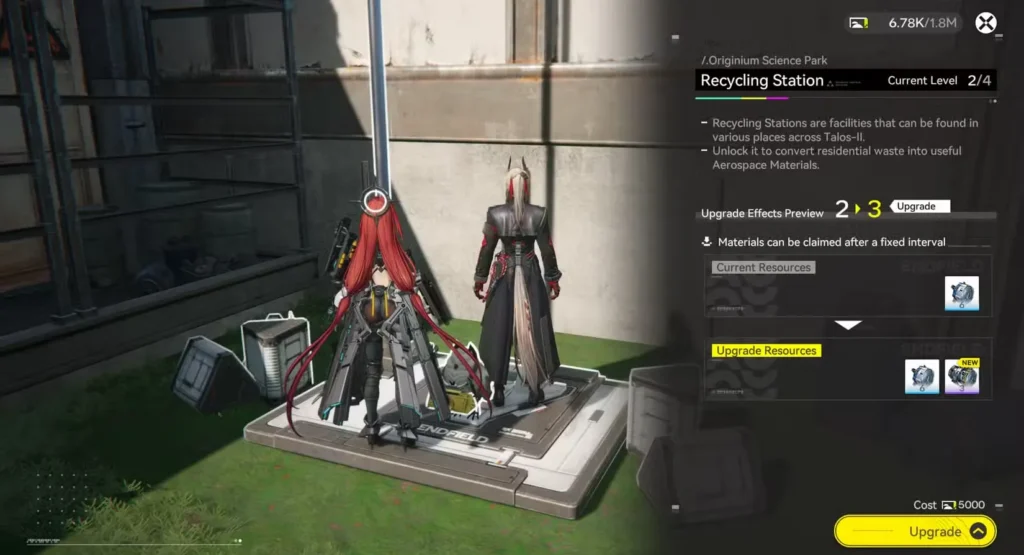
Basic Recycling Stations provide only 3 Aerospace Materials I per collection cycle — functional for the very early game, but insufficient once Cabin construction and Control Nexus upgrades start demanding larger quantities. Every station can be upgraded from Level 1 to Level 4 using regional Stock Bills.
Here’s what each upgrade tier unlocks:
- Level 1 (default): 3 Aerospace Material I per batch
- Level 2: Increased Aerospace Material I quantity
- Level 3: Unlocks Aerospace Material II drops (3 purple-rarity materials per batch). Cost is approximately 6,000 Stock Bills per station — relatively cheap compared to other Stock Bill expenditures and a practical early target.
- Level 4: Doubles Aerospace Material II output (6 purple materials per batch). Costs approximately 20,000 Valley Stock Bills per station. Worth pursuing once your Outpost trading income has stabilized.
Upgrade priority advice: Target the Hub area stations first — they sit closest to fast-travel points and give the best time-to-material ratio. Push all Hub stations to Level 3 as your first goal (unlocking Aerospace Material II), then continue to Level 4 once income allows. Wuling stations become essential once you need Aerospace Material II for Level 3+ Control Nexus upgrades. Upgrading stations also increases your Regional Development Level, providing additional progression benefits beyond just material yield.
Earning Stock Bills for Upgrades
Station upgrades require Stock Bills — regional currency distinct from the T-Creds used for Operator advancement. Stock Bills are region-specific (Valley Stock Bills for Valley IV, etc.), so they can’t be freely transferred between areas.
The most reliable acquisition method is Outpost trading. Your AIC factories produce various materials and processed goods that nearby Outposts will purchase in exchange for Stock Bills. Key things to know:
- Different items sell for different prices, and market demand shifts over time
- Processing raw materials into refined goods typically returns more Stock Bills than selling basic resources
- Each Outpost has a Stock Bill cap — trade regularly to avoid losing accumulated value
- Station upgrades should be among your first Stock Bill expenditures — the passive Aerospace Material income compounds over time, and delaying upgrades means permanently missing daily batches you can never recover
For factory optimization strategies, explore our guides on battery production, expanding Core AIC area, and Quick Stash management.
Strategic Outpost Trading
Turning factory output into Stock Bills requires more than just dumping excess materials at the nearest Outpost. Consider these optimization tactics:
Monitor price fluctuations — Outpost needs change over time. What sells for premium rates today might be worthless tomorrow. Check prices regularly before committing to large production runs.
Respect the Stock Bill cap — Every Outpost has a maximum Stock Bill balance. If you let it hit the cap without collecting, new trades generate nothing. Make Outpost collection part of your same daily loop as Recycling Station visits.
Diversify your product portfolio — Don’t focus exclusively on one tradeable item. Spreading production across multiple goods provides flexibility when market conditions shift.
Balance production capacity — Ramping up factory output to maximize trading income means ensuring your power infrastructure and logistics chains can support the increased throughput.
For additional base management strategies, check out our guides on increasing power output and Gear Templates.
Investing Aerospace Materials in the OMV Dijiang
Once you’ve accumulated Aerospace Materials, spending them strategically maximizes your returns. There are two primary upgrade systems aboard the OMV Dijiang, and they’re connected — Control Nexus level gates how many Cabins you can build.
Control Nexus Upgrades
The Control Nexus is the central management terminal of the Dijiang. Each upgrade level requires Aerospace Materials plus an Algorithm Expansion Chip (earned from the “Dijiang Upgrade and Maintenance” quest chain — one chip per quest) and T-Creds. The Algorithm Chip is your actual bottleneck for Control Nexus upgrades, not the Aerospace Materials themselves.
Level 2 is the single most impactful upgrade — it unlocks the Growth Chamber (your primary source of rare operator promotion materials), adds a third operator assignment slot, and raises MFG Cabin capacity. Prioritize reaching this as fast as possible.
Cabin Construction
Additional Cabins enable passive production of valuable materials including rare resources like Red Boletes, Kalkonyx, fungal growths for promotion, crystalline growths for skill enhancement, and rare minerals for weapon advancement. These run continuously — even offline — providing steady income without active gameplay.
One important operational note: operators assigned to Dijiang facilities gradually deplete their Mood stat. When Mood reaches zero, they automatically leave to rest in the Central Ring, halting production bonuses. Monitor operator Mood during long sessions and rotate assignments to keep production running smoothly.
Planning your upgrade path matters. Some Cabin types produce universally useful materials (Growth Chamber, Manufacturing Cabin), while others generate specialized resources. Consider your current bottlenecks before committing materials to new construction.
For character development guidance, explore our resources on leveling and promoting characters, Endministrator builds, and Last Rite optimization.
Long-Term Collection Strategy
Aerospace Material acquisition rewards consistency over intensity. Here’s how to maintain steady growth:
Build a daily collection habit — All stations reset at 5:00 AM server time. Establishing a once-daily collection loop, ideally shortly after the reset, ensures you never miss a batch. Missed days are permanently lost income since materials don’t accumulate.
Establish efficient collection routes — Most stations sit near Tele-Protocol Points. Plan routes that chain multiple stations together with minimal backtracking. Build zipline pylons near any outlying stations to cut travel time further.
Use the area map to check station readiness — Cycle through each sub-area’s map to see which stations are showing as full before you set off. This saves time by letting you plan the most efficient collection order.
Prioritize Hub station upgrades first — The three Hub stations offer the best time-to-material ratio because they’re closest to fast-travel. Get them to Level 3 (Aerospace Material II unlocked) as your first goal, then expand outward.
Scale factory production for trading — Your Stock Bill income directly limits upgrade speed. Expanding production capacity for high-value trade goods accelerates station improvements, which in turn boost your daily Aerospace Material haul.
For gameplay optimization across different areas, check out our guides on best settings, stats mechanics, and elemental reactions.
Getting Started with Arknights Endfield
New players can download Arknights Endfield from the official website, get it on Google Play, or install it via the Epic Games Store.
For additional gameplay assistance, explore our guides on switching Endministrators, gacha mechanics, and multiplayer features.
Frequently Asked Questions
How many Recycling Stations are there in total?
There are 13 confirmed Recycling Stations across the current game world — 9 in Valley IV (spread across The Hub, Valley Pass, Aburrey Quarry, Originium Science Park, Origin Lodespring, and Power Plateau) and 4 in Wuling (3 in Jingyu Valley, 1 in Wuling City). Some are locked behind story or Outpost progression milestones, so you may not be able to access all of them immediately.
When do Recycling Stations reset, and do materials stack if I miss a day?
All Recycling Stations reset daily at 5:00 AM server time. Materials do NOT stack — if you miss a day, the station holds one full batch but won’t accumulate extra rewards for additional days you skip. There is no catch-up mechanic. Consistent daily collection is the only way to maximize your Aerospace Material income.
Should I upgrade all Recycling Stations equally or focus on specific ones?
Focus upgrades on The Hub stations first — they’re closest to fast-travel points and give the best time-to-material ratio. Getting them to Level 3 (which unlocks Aerospace Material II at ~6,000 Stock Bills per station) should be your first priority. Avoid spreading upgrades too thin early on; concentrating on stations you actually visit daily gives far better returns than upgrading remote stations that may go uncollected for days.
What’s the most efficient way to farm Stock Bills for station upgrades?
Open your Outpost Management screen and identify which products currently command the highest prices, then configure factory production to emphasize those items. Processing raw materials into refined goods typically yields more Stock Bills than selling basic resources. Also be mindful that each Outpost has a Stock Bill cap — collect regularly or you’ll be leaving currency on the table. Prioritize Recycling Station upgrades as your first Stock Bill expenditure since the compounding daily material income is impossible to recover if you delay.
What’s actually the bottleneck for Control Nexus upgrades — Aerospace Materials or something else?
Algorithm Expansion Chips are the real bottleneck for Control Nexus upgrades, not Aerospace Materials. You earn one chip per completion of the ‘Dijiang Upgrade and Maintenance’ quest chain missions. T-Creds are needed too but rarely a problem for most players. Aerospace Materials are the bottleneck specifically for Cabin construction, which is why consistent daily Recycling Station visits matter so much from the start.
Do higher-rarity Aerospace Materials come from upgraded stations automatically?
Yes — upgrading a Recycling Station to Level 3 automatically adds Aerospace Material II to its drop pool (approximately 3 purple-rarity materials per batch). Upgrading to Level 4 doubles the Aerospace Material II output to 6 per batch. You don’t need to do anything beyond the upgrade itself. This is why reaching Level 3 on your most-visited stations is a top-priority early investment.