Alright, let’s talk stats. If you’ve played other action gacha games, you might think you know what to expect—but Arknights Endfield throws in a few curveballs that make character building a bit more interesting than your typical “stack ATK and crit” approach.
The good news? Once you understand how everything connects, building your Operators becomes pretty intuitive. The even better news? I’m going to break down exactly what each stat does and why it matters for your builds.
Before we dive deep into the numbers, make sure you’re familiar with how combat actually works in Endfield, since stats directly influence your damage output and reaction strength. New to the game? Start with our complete guides hub to get up to speed. You can download the game from the official website, Google Play, or Epic Games Store.
The Attribute System: Endfield’s Unique Twist
Here’s where Endfield does things differently. Instead of just stacking raw stats like you might in Genshin Impact or Wuthering Waves, every Operator has four core Attributes that influence multiple aspects of their performance. Think of these as the foundation that everything else builds on.
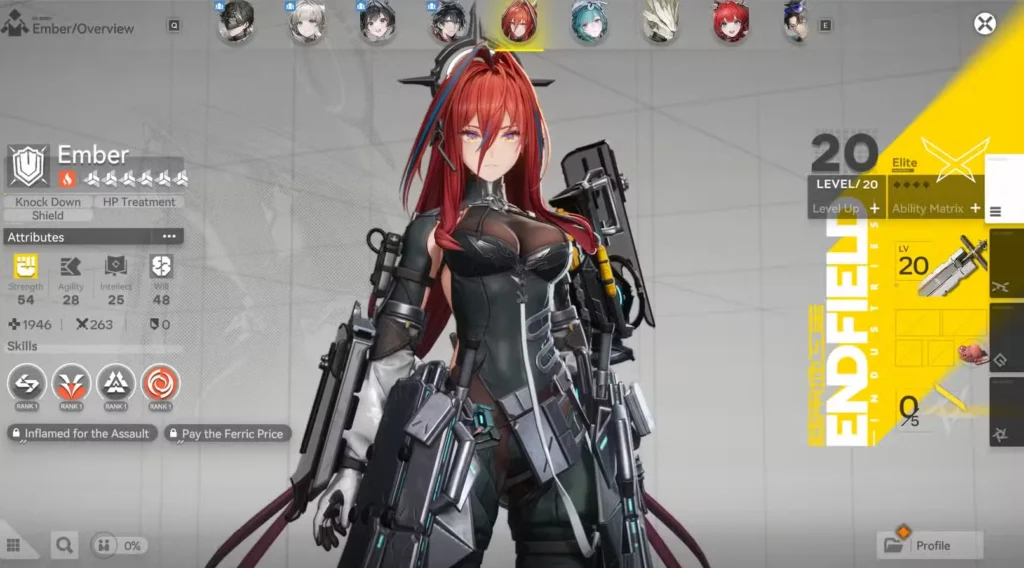
The Four Primary Attributes
Strength
- Directly increases your Base HP
- More Strength = tankier character
- Essential for frontline Operators who need to absorb damage
Agility
- Boosts Physical Resistance
- Reduces damage from Physical attacks
- Important for characters who’ll be facing predominantly Physical enemies
Intellect
- Enhances Arts Resistance
- Your defense against elemental damage
- Critical for surviving Arts-heavy encounters
Will
- Directly affects Treatment Bonus
- Makes your healing abilities stronger
- Your healer’s best friend—more Will means more effective recovery
But here’s the twist that makes this system interesting: these Attributes don’t just do what’s listed above.
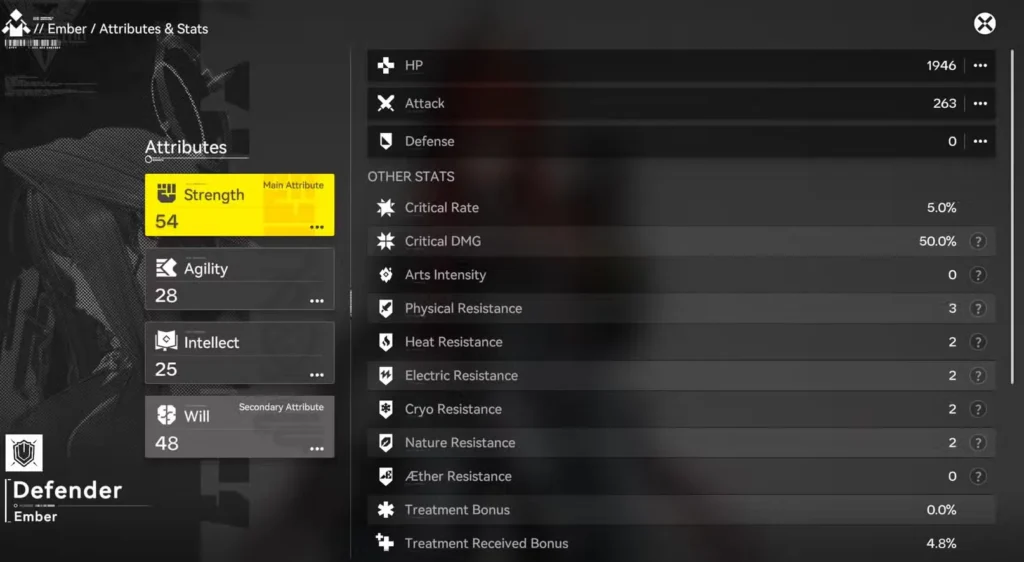
Main and Secondary Attributes: Your Hidden ATK Boost
Pop open your Character menu and inspect any Operator closely. You’ll notice something specific about their Attributes—one has a yellow background (Main Attribute), and another has a gray background (Secondary Attribute).
This is huge for understanding how to build your characters properly.
Both your Main and Secondary Attributes directly contribute bonus ATK to your Operator. The higher these numbers are, the more damage you’ll deal. So that Strength stat on your tank? It’s not just giving HP—if it’s their Main or Secondary Attribute, it’s also pumping up their attack power.
This creates some interesting build diversity. A Strength-focused character might be naturally tanky and hit hard, while an Intellect-based Operator gains both Arts resistance and offensive power.
Matching Weapons to Attributes
Pay close attention to the Attributes your weapons provide. While Endfield doesn’t have strict Attribute requirements to equip gear (which is nice—no frustrating equipment restrictions), you’ll get way more value from weapons that align with your Operator’s Main and Secondary Attributes.
Using a weapon that buffs Strength on a Strength-based character is just smart math. You’re getting both the defensive benefit AND the offensive ATK boost. Using mismatched gear isn’t the end of the world, but you’re definitely leaving power on the table.
Core Combat Stats Explained
Beyond Attributes, Endfield uses the standard suite of combat stats you’d expect from an action gacha. These are straightforward but absolutely critical for optimizing your builds. Here’s what you need to know:
Offensive Stats
Critical Rate
- Your chance to land a Critical Hit
- Standard crit mechanics—higher percentage means more frequent crits
- Generally want to balance this with Critical DMG for efficiency
Critical DMG
- How hard your Critical Hits actually strike
- Expressed as a percentage multiplier
- Stacking this without sufficient Crit Rate is inefficient (and vice versa)
Arts Intensity
- This one’s special—affects both Physical Statuses and Arts Inflictions
- Makes your elemental reactions and status effects hit harder
- Directly scales Arts Burst damage and reaction potency
- If you’re running an elemental-focused build, this stat is gold
DMG Bonuses
- Increases damage for specific damage types (Physical, Heat, Cryo, Electric, Nature)
- More focused than general ATK increases
- Stack these for specialized builds that lean heavily into one damage type
Defensive Stats
Physical Resistance
- Reduces incoming Physical damage
- Boosted by Agility Attribute
- Check enemy types before stacking this—useless if they deal Arts damage
Arts Resistance
- Reduces incoming Arts (elemental) damage
- Boosted by Intellect Attribute
- Critical for surviving elemental-heavy content
Elemental Resistances
- Specific resistances to Heat, Cryo, Electric, and Nature damage
- More specialized than general Arts Resistance
- Useful when you know exactly what you’re up against
Support and Utility Stats
Treatment Bonus
- Makes your outgoing healing stronger
- Influenced by Will Attribute
- Essential stat for dedicated healers
- Higher numbers mean your team stays alive longer
Treatment Received Bonus
- Makes incoming healing more effective on this character
- Great for tanks who need sustain
- Stacks multiplicatively with Treatment Bonus for massive recovery
Combo Skill Cooldown
- Reduces how long you wait between Combo Skills
- More frequent skills = more reactions and control
- Especially valuable for characters with powerful combo abilities
Ultimate Gain Efficiency
- Boosts how quickly your Ultimate meter fills
- Get your big damage/utility abilities online faster
- Can dramatically change your rotation timing
Stagger Efficiency Bonus
- Determines how much Stagger you inflict on enemies
- Stagger breaks enemy defenses and creates openings
- Important for characters designed around breaking enemy posture
Building Your Operators: Practical Application
Understanding stats is one thing—actually using that knowledge to build powerful characters is another. Here’s how to approach it:
Step 1: Identify Main and Secondary Attributes Check what your Operator’s yellow and gray Attributes are. These should guide your weapon and gear choices.
Step 2: Match Gear to Role
- DPS characters want ATK, Crit Rate, Crit DMG, and relevant DMG Bonuses
- Elemental specialists need Arts Intensity alongside standard DPS stats
- Tanks prioritize Strength, HP, and appropriate Resistances
- Healers stack Will, Treatment Bonus, and survivability
Step 3: Don’t Ignore Sets Specific Gear sets provide significant bonuses that can outweigh individual stat pieces. Sometimes a set bonus is worth running slightly suboptimal individual pieces. Finding the right optimal settings can also help you see these bonuses more clearly during combat.
Step 4: Balance Your Stats Stacking one stat to the exclusion of others usually creates diminishing returns. A balanced approach—like maintaining a good Crit Rate to Crit DMG ratio—generally performs better than going all-in on one number.
Stats and Team Composition
Your individual Operator stats matter, but they exist within a team context. That Treatment Bonus on your healer? It affects your entire squad’s survivability. That Arts Intensity on your elemental DPS? It makes your elemental reaction combos way more devastating.
When building teams for multiplayer co-op, coordinate with your teammates. If someone’s already running a pure Physical damage dealer, maybe spec your character toward Arts damage to cover different enemy types.
Stat Priority by Operator Role
DPS Operators:
- Main/Secondary Attributes (for ATK boost)
- Critical Rate and Critical DMG (balanced ratio)
- Relevant DMG Bonuses
- Arts Intensity (if elemental-focused)
Tank Operators:
- Strength (HP and potentially ATK)
- Appropriate Resistances (Physical or Arts based on content)
- Treatment Received Bonus
- Some offensive stats (they still need to contribute)
Healer Operators:
- Will (Treatment Bonus)
- Survivability stats (they can’t heal if they’re dead)
- Combo Skill Cooldown (more frequent healing windows)
- Ultimate Gain Efficiency (faster access to emergency heals)
Support/Hybrid Operators: This varies heavily by character. Check their kit and build toward their strengths—some want Arts Intensity for inflictions, others want Stagger Efficiency for control.
Getting the Gear You Need
Obviously, you need actual equipment to get these stats. If you’re just starting out, our reroll guide can help you land strong characters worth investing in. Don’t forget to check for active redeem codes for free pulls and resources.
Looking for specific characters to build around certain stat distributions? Our characters guide breaks down who excels in different roles. And if you’re watching streams while farming gear, grab those Twitch Drops for bonus rewards.
FAQs
What’s the difference between Main and Secondary Attributes?
Both your Main Attribute (yellow background) and Secondary Attribute (gray background) provide bonus ATK to your character, but typically in different amounts—Main Attribute usually gives more. Beyond the ATK boost, each Attribute also provides its listed benefit (HP, resistances, or Treatment Bonus). Focus on gear that boosts whichever two Attributes your Operator has highlighted.
Should I prioritize Attributes or regular stats like Crit Rate?
It depends on your character’s role and current gear. Attributes provide foundational benefits that scale throughout the game, but you still need sufficient offensive stats (Crit Rate, Crit DMG) to actually deal damage. Generally, match your Main/Secondary Attributes with gear choices, then optimize your crit ratios and damage bonuses within that framework.
How much Arts Intensity do I need for elemental builds?
There’s no hard breakpoint, but Arts Intensity becomes increasingly valuable the more you rely on elemental reactions and Arts Bursts. For characters who frequently trigger reactions, prioritize it alongside your standard DPS stats. For characters who just occasionally apply inflictions, it’s lower priority than Crit and ATK stats.
Do stats from different gear pieces stack additively or multiplicatively?
Most stats in Endfield stack additively—if you have +10% Crit Rate from one piece and +15% from another, you get +25% total. However, damage calculations themselves involve multiplication (base damage × crit damage × damage bonuses × resistance calculations), which is why balanced stat distributions often outperform heavily skewed builds. Treatment Bonus and Treatment Received Bonus also multiply together, making healer-tank combos especially effective.